 |
Database of Biochemical Tests of Pathogenic Enterobacteriaceae Family A tool to identify microbes using minimal biochemical tests |
|
Erwinia carotovora
| About Organism | Show All Tests | Show Unique Test Hierarchy |
Details
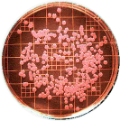
| Description | Erwinia carotovora known as Pectobacterium carotovorum . Erwinia carotovora is a Gram-negative, rod shaped bacterium that was named after the crop of carrots from which it was first isolated.Rods shaped,Motile by means of peritrichous flagella. No capsules present. |
| Synonyms | Pectobacterium carotovorum;Bacterium carotovorum;Bacillus carotovorus. |
| Habitat/Source | These widespread microbes can be found in soil, guts of insects, water and suspended aerosols in air. |
| Pathogenicity | The bacterium infects a variety of vegetables and plants including carrots, potatoes, cucumbers, onions, tomatoes, lettuce and ornamental plants like iris. I causes a rapid soft rot of roots,rhizomes, fruits and the fleshy stems of a variety of plants.Erwinia carotovora causes death by creating an osmotically fragile cell. It produces extracellular pectic enzymes that destroy the integrity of the pectin. To a lesser extent, it produces an extracellular cellulase to degrade cellulose. Other exported enzymes thought to be important in pathogenesis include hemicellulases, arabanases, xylanases and a protease. |
| GenBank Accession | View Genome [NC_012917.1] |
| Size(Mb) | 4.86291 |
| GC% | 51.9 |
| Genes | 4290 |
| CDS | 4163 |
| Reference | (1) Waldee, E.L. "Comparative studies of some peritrichous phytopathogenic bacteria." Iowa State Coll. J. Sci. (1945) 19:435-484. (2) Bergey's Manual of Determinative Bacteriology (9th Edition,p.207,Table 5.2).Edited by John G. Holt,The Williams & Wilkins Co.. |