 |
Database of Biochemical Tests of Pathogenic Enterobacteriaceae Family A tool to identify microbes using minimal biochemical tests |
|
Yersinia pestis
| About Organism | Show All Tests | Show Unique Test Hierarchy |
Details
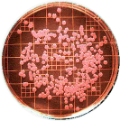
| Description | It was discovered in Hong Kong in 1894 by a Swiss physician Alexandre Yersin. Yersinia pestis is a rod shaped gram-negative bacteria that can also have a spherical shape. It is also covered by a slime envelope that is heat labile. When the bacteria is in a host, it is nonmotile (incapable of self-propelled movement),but when isolated it is motile. |
| Synonyms | Yersinia pseudotuberculosis subsp. pestis; Pestisella pestis; Pasteurella pestis; Bacterium pestis; Bacillus pestis. |
| Habitat/Source | Yersinia pestis interacts mainly with rodents such as rats and fleas. Through these carriers,Yersinia pestis is able to invade human cells and create diseases. Yersinia pestis is found world wide but mainly in Central Asia and Central Africa;Iran and the europe. |
| Pathogenicity | Yersina pestis is the causative agent of plague. Yersinia pestis causes bubonic and pneumonic plague. Bubonic plague is transmitted by the bite of infected rat fleas. Swollen,blackened lymph nodes (buboes) develop,followed by septicemia and hemorrhagic pneumonia and death. The pneumonic form spreads directly from human to human via respiratory droplets. Outbreaks are explosive in nature, and invariably lethal. In bubonic plague,the bacilli spread from a local abscess at the flea bite site to draining lymph nodes;followed rapidly by septicemia and hemorrhagic pneumonia. |
| GenBank Accession | View Genome [NC_003143.1] |
| Size(Mb) | 4.82986 |
| GC% | 47.61 |
| Genes | 4230 |
| CDS | 3979 |
| Reference | (1) nisimov, A.P., Lindler, L.E., and Pier, G.B. "Intraspecific diversity of Yersinia pestis." Clin. Microbiol. Rev. (2004) 17:434-464. (2) Bergey's Manual of Determinative Bacteriology (9th Edition,p.221,Table 5.2).Edited by John G. Holt,The Williams & Wilkins Co.. |